SOC 2 itself hasn't been rewritten for 2026 — the AICPA's five Trust Services Criteria are the same ones introduced in 2017. What changed is how auditors interpret and test them: continuous risk assessment, deeper vendor scrutiny, zero-trust access controls, and more detailed reporting are now the norm, not the exception. This is a plain guide to SOC 2 updates 2026 brings — six real shifts, drawn from the audits we've run and the 2024 SOC benchmark study, and what busy teams need to do about each one. In practice, the new SOC 2 2026 requirements show up as deeper vendor oversight, zero-trust access controls, and more detailed reporting, not a new framework to learn.
At a Glance: SOC 2 Changes for 2026
| Shift | What's changing | Who's most affected |
|---|---|---|
| Continuous, risk-based assessment | Annual checklists give way to ongoing risk evaluation. Auditors expect evidence that risk assessments are revisited regularly, not done once a year. | Compliance/security leads running the program |
| Vendor and supply-chain risk | Documented vendor tiering, onboarding, and continuous monitoring are now expected. Subservice providers appear in 89.6% of reports. | Vendor management owners, procurement |
| Zero-trust and modern architecture | MFA, least-privilege access, and network segmentation are moving from best practice to baseline expectation. | IT and security engineering |
| Tightened reporting standards | Reports are getting more detailed. 23% now cover 150+ controls, up from 16%. | Whoever owns the audit relationship |
| Cross-framework alignment | SOC 2 is increasingly mapped to HIPAA, ISO 27001, GDPR, and DORA to cut duplicate audit work. | Companies holding multiple certifications |
| Transparency and due-diligence readiness | An up-to-date Type II report and fast questionnaire turnaround are now baseline, not a differentiator. | Sales and GTM teams supporting enterprise deals |
What SOC 2 Covers and Why It Matters
At its core, the SOC 2 framework is an attestation scheme created by the American Institute of Certified Public Accountants (AICPA). It produces a report on controls at a service organisation that are relevant to the security, availability and processing integrity of the systems that handle customer data and the confidentiality and privacy of that information. Enterprise buyers rely on SOC 2 reports as evidence that a vendor has designed and operates its controls effectively.
Types of SOC 2 reports. A Type I report describes the design of controls at a specific point in time, whereas a Type II report tests the operating effectiveness of those controls over an observation period — usually three to 12 months. Enterprise clients typically want Type II reports because they demonstrate how controls perform in real operations. Healthcare customers often insist on Type II because of the sensitive nature of protected health information.
The table below recaps the five Trust Services Criteria (TSC) and how they apply. Security is mandatory for every SOC 2 examination. The other categories are optional and are included when the vendor's services expose additional risks or when buyers request them.
| Trust Services Criteria | Purpose | Example controls |
|---|---|---|
| Security (mandatory) | Ensures information and systems are protected against unauthorised access, disclosure and damage. | Control environment, logical/physical access, identity management, encryption, change management |
| Availability | Ensures systems and information are available for operation and use. | Disaster recovery, uptime monitoring, capacity planning |
| Confidentiality | Ensures information designated as confidential is protected. | Data classification, encryption, secure storage |
| Processing Integrity | Ensures system processing is complete, valid, accurate, timely and authorised. | Input validation, transaction logging, reconciliation |
| Privacy | Ensures personal information is collected, used, retained and disposed according to commitments. | Consent management, data minimisation, breach notification |
Controls — policies, procedures and technical safeguards — are the mechanisms that address these criteria. Examples include identity and access management, multi-factor authentication, encryption at rest and in transit, change-management workflows, logging, monitoring and incident response. In practice, a SOC 2 Type II examination can involve 60–150 control points. A 2024 benchmark study found that 23% of SOC 2 reports contained more than 150 security controls, reflecting a more rigorous approach to compliance.
Two 2022 AICPA guidance updates are already shaping how this plays out: management must now explicitly disclose its risk assessment process, and the points of focus have been modernised to cover emerging technologies and threats. The data bears this out: confidentiality now appears in 64.4% of SOC 2 reports, up from 34% in 2023, and 89.6% of reports include subservice providers, up from 82% the year before. In practice, that means Type II reports increasingly require evidence that controls operate consistently over time, not just that they exist on paper.
Auditors now want real security, not a SOC 2 checklist.
Share your work email and build a security posture that passes audits.
SOC 2 Updates 2026: What Actually Changed
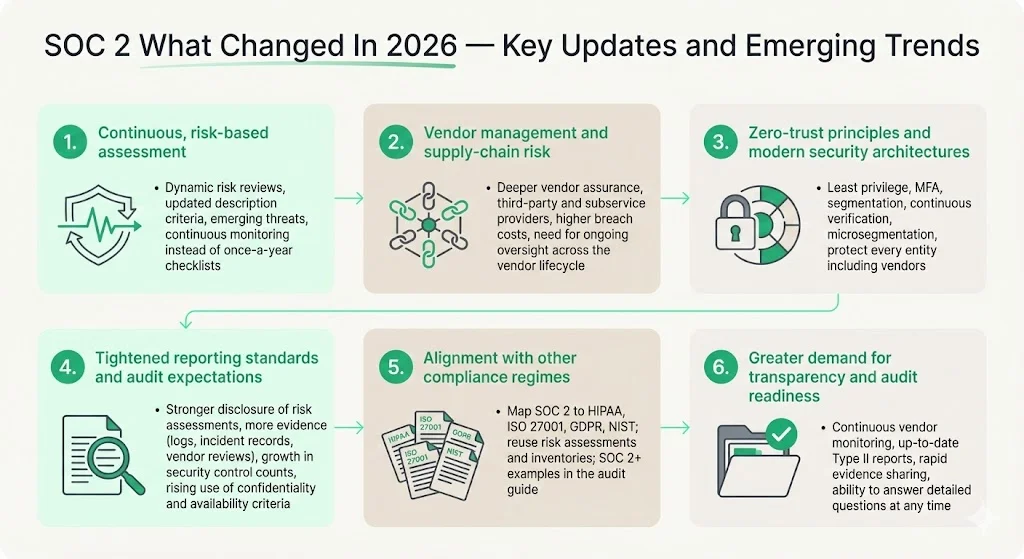
The AICPA hasn't released a wholly new version of SOC 2 for 2026. Instead, the changes reflect shifts in risk, technology and enterprise expectations. Here are the six updates practitioners are seeing show up in real audits.
1. Greater emphasis on continuous, risk-based assessment
Point-in-time checklists no longer satisfy auditors. Updated AICPA guidance calls for management to disclose its risk assessment process and revisit it regularly, and the shift shows up in the numbers: a Recorded Future analysis found 30% of 2024 data breaches involved a third-party vendor, double the year before, underscoring why static, once-a-year reviews leave blind spots. We see this firsthand: across the SOC 2 audits we've run over the past 12 months, 63% of clients who came to us from modern GRC platforms had a gap in proving continuous control effectiveness — often on basics as simple as multi-factor authentication on email and cloud accounts — before we started working with them. For what continuous, risk-based monitoring looks like in practice, see our SOC 2 continuous monitoring guide.
2. Heightened scrutiny of vendor management and supply-chain risk
With most providers relying on cloud hosts, payment processors, and SaaS partners, auditors are scrutinising vendor risk more closely than ever. Nearly 90% of SOC 2 reports now include subservice providers, and third-party breaches cost roughly 40% more to remediate than incidents originating in-house. Auditors increasingly expect documented vendor tiering, onboarding, and continuous monitoring, mapped to trust criteria like CC2.3, CC3.2, and CC9.2. For the full walkthrough, including templates for vendor risk assessments and monitoring cadences, see our SOC 2 third-party risk guide and step-by-step vendor risk mapping guide.
3. Adoption of zero-trust principles and modern security architectures
Zero-trust security has moved from theory to practice. The U.S. federal government's strategy calls for agencies to use single sign-on with multi-factor authentication, maintain inventories of all devices, encrypt all DNS and HTTP traffic, treat every application as internet-accessible and categorise data for targeted protections. These goals reflect the core tenets of zero trust: continuous verification, least-privilege access and breach assumption.
In a zero-trust environment, network assets are inaccessible by default, and users, devices and workloads must pass continuous, contextual authentication and validation to access resources. Permissions are restricted to the minimum needed and revoked when the session ends. Zero-trust organisations assume attackers are already inside the network and employ microsegmentation, monitoring and rapid response to contain breaches. These principles extend to supply-chain security: zero trust applies continuous, contextual authentication and least-privilege access to every entity, including vendors, so that if a vendor account is compromised it cannot access sensitive resources.
For SOC 2 in 2026, auditors and clients expect evidence that service organisations implement modern access controls, network segmentation, multi-factor authentication and least-privilege policies. Identity and access reviews, device inventories, API security and microsegmentation are becoming standard control expectations. While zero trust is not explicitly required by SOC 2, it aligns with the "logical and physical access controls" and "risk mitigation" points of focus under the security TSC.
4. Tightened reporting standards and audit expectations
As enterprise compliance demands rise — particularly in regulated sectors such as healthcare and finance — SOC 2 reports are expected to be more comprehensive. The AICPA's revised SOC 2 description criteria emphasise disclosure of formal risk assessments. Points of focus now call for coverage of new threats, technologies and vulnerabilities. Service auditors may request more detailed evidence, such as logs showing continuous monitoring, incident response records, vendor risk assessments and automated control workflows.
The 2024 SOC benchmark study found that reports containing more than 150 security controls rose from 16% to 23%. Confidentiality is now included in 64.4% of SOC 2 reports, up from 34% in 2023, and availability appears in 75.3%. These trends suggest that service organisations are expanding scope to address client requirements. Meanwhile, reliance on internal audit to reduce testing dropped to 5.2% of SOC reports, likely because updated AICPA guidance reduces the weight given to internal audit.
5. Alignment with other regulatory and compliance regimes
Many enterprise buyers operate under multiple frameworks — HIPAA for healthcare data, ISO 27001 for information security management, the General Data Protection Regulation (GDPR) for privacy, or the Digital Operational Resilience Act (DORA) in Europe. They expect their vendors to align SOC 2 controls with these regimes. The AICPA's SOC 2 Audit Guide includes examples of SOC 2+ reports that integrate HIPAA privacy rules, ISO 27001, NIST and HITRUST. Updated guidance emphasises clarifying system boundaries and addressing third-party software.
For 2026, expect a stronger push to map SOC 2 controls to other frameworks. Organisations that operate an Information Security Management System (ISMS) under ISO 27001 can reuse risk assessments, asset inventories and Statement of Applicability (SoA) to support SOC 2. Similarly, vendors handling health data may align SOC 2 privacy criteria with HIPAA's administrative, physical and technical safeguards and Business Associate Agreements (BAAs). Cross-framework mapping reduces duplication and helps meet buyer expectations.
6. Greater demand for transparency and audit readiness during due diligence
Transparency and audit readiness are what due diligence now runs on. Enterprise procurement teams are adopting continuous vendor monitoring. According to Recorded Future, half of companies now work with more than 100 vendors, and static questionnaires leave them blind between review cycles. Buyers increasingly expect vendors to share up-to-date SOC 2 reports, control attestations and evidence of continuous monitoring. For many technology vendors, having a current Type II report is now a minimum requirement.
In this context, this shift means vendors must be ready to produce documentation quickly, answer detailed security questionnaires and support their claims with verifiable evidence. The ability to present a well-maintained SOC 2 report and show ongoing control effectiveness will differentiate vendors from competitors who treat compliance as a one-time exercise.
Free checklist
The SOC 2 Compliance Checklist
A phase-by-phase checklist covering scoping, the Trust Services Criteria, the readiness gap assessment, the observation window, and audit fieldwork, just enter your work email.
Practical Guidance for Teams Preparing for 2026
Konfirmity has delivered security and compliance outcomes for hundreds of SaaS and cloud providers. We operate as a human-led, managed service — implementing controls inside your stack and keeping you audit-ready year-round. Our experience shows that busy teams can be ready for a SOC 2 Type II examination in 4–5 months with about 75 internal hours when they work with us, compared with 9–12 months and 550–600 hours if they try to manage everything themselves. Here are the steps we advise.
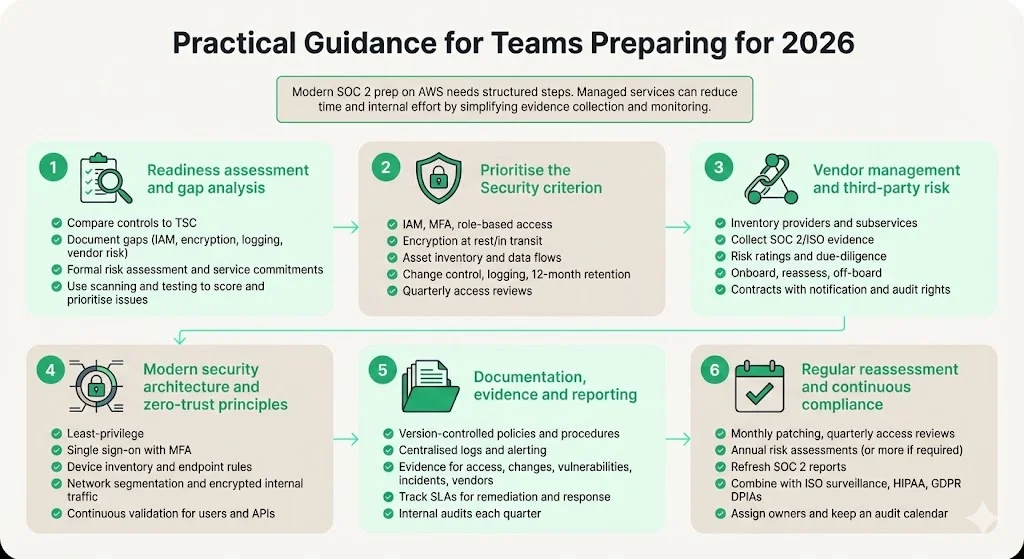
1) Conduct a readiness assessment and gap analysis
Start by comparing your current controls against the Trust Services Criteria. Document policies, procedures and technical safeguards; identify gaps in identity management, access control, encryption, change management, logging, incident response and vendor oversight. Make sure you have a formal risk assessment covering service commitments and system requirements. Tools such as Common Vulnerability Scoring System (CVSS) scanning, penetration testing and vulnerability management help quantify risk and prioritise remediation. A readiness assessment typically takes two to three weeks and yields a gap list with severity and remediation actions. For a structured, step-by-step version of this process, see our SOC 2 Compliance Checklist.
2) Prioritise the Security criterion as your baseline
Security is mandatory for every SOC 2 report. Establish strong identity and access management (IAM). Implement multi-factor authentication, role-based access control and segregation of duties. Encrypt data at rest and in transit. Maintain an asset inventory and document data flows. Establish change-management procedures with peer review and automated pipelines. Enable centralised logging and monitoring; aggregated logs should be retained for at least 12 months for auditability and incident response. Perform quarterly access reviews and remove dormant accounts. Once security controls are solid, decide whether to add availability, processing integrity, confidentiality or privacy based on client needs and the nature of your service. Adding criteria increases cost and complexity, so ensure there is a clear business driver. Our SOC 2 cost calculator shows how each added criterion moves your budget.
3) Adopt vendor management and third-party risk practices early
Maintain a complete inventory of vendors and subservice providers. Collect and review their SOC 2 reports, ISO certifications and security questionnaires. Document risk ratings and due-diligence results. Build policies for vendor onboarding, periodic reassessment and off-boarding. Use contract clauses to require notification of security incidents, data breach reporting and right-to-audit. Automate vendor risk assessments and continuous monitoring where possible. Trust services criteria such as CC2.3 (communication), CC3.2 (risk identification) and CC9.2 (vendor risk management) are a useful structure for your programme.
4) Implement modern security architectures and zero-trust principles
Implementing modern security architectures starts with zero-trust principles: move beyond perimeter-based defences. Adopt least-privilege access: grant users only the permissions they need, and revoke them when tasks are complete. Use single sign-on with multi-factor authentication and identity federation across internal and SaaS applications. Maintain an inventory of devices and enforce endpoint compliance. Segment networks into microzones and limit lateral movement; encrypt internal traffic. Monitor all requests and sessions; if behaviour deviates from baseline, trigger re-authentication or block access. For workloads and APIs, use dynamic authorisation and enforce continuous validation. These measures map to the security TSC points of focus CC6 (logical and physical access), CC7 (system operations) and CC9 (risk mitigation).
5) Maintain documentation, evidence and reporting readiness
Reporting readiness means version-controlled documentation for policies, procedures and system descriptions, plus evidence that survives the full 6–12 month observation window. Automate log collection from infrastructure, applications and third-party services. Retain logs in a central repository with correlation and alerting capabilities. Document control performance with evidence such as access reviews, change records, vulnerability scans, incident tickets and vendor assessments. Keep track of Service Level Agreements (SLAs) for vulnerability remediation and incident response. Conduct internal audits at least quarterly to verify control operation. When working with Konfirmity, we handle evidence collection and organise it for auditors, reducing the burden on your team.
6) Plan for regular reassessment and continuous compliance
SOC 2 Type II demands sustained evidence across 64+ control points. Treat compliance as a continuous operation, not a project. Schedule recurring control activities — such as monthly patching, quarterly access reviews and annual risk assessments. Refresh your SOC 2 report at least annually; some enterprise clients require semi-annual assessments — see our SOC 2 renewal guide for the exact timeline. Integrate SOC 2 with ISO 27001 surveillance audits, HIPAA risk analyses and GDPR Data Protection Impact Assessments (DPIAs) to streamline effort. Maintain an audit calendar and assign owners for each control. A human-led managed service ensures continuity when personnel change or budgets fluctuate.
SOC 2 and Enterprise Sales: Using Compliance as a Trust Signal
Security diligence now happens early in procurement. Enterprise buyers issue lengthy questionnaires, request SOC 2 reports, BAAs, DPAs and security addenda, and scrutinise control evidence. Deals can stall if vendors cannot answer questions or provide recent attestation. A current SOC 2 report tells buyers that your controls have been independently tested. For healthcare buyers, demonstrating HIPAA compliance and strong privacy controls builds confidence.
When you use a managed service like Konfirmity, you are always ready for due diligence. We integrate controls into your product and infrastructure, collect evidence automatically and maintain your SOC 2 report. This approach gives you a response advantage — deals close faster because you can provide auditors and procurement teams with clear, up-to-date documentation. It also differentiates you from competitors who rely on self-serve GRC tools or one-off consultants. We design and operate the controls so that compliance follows naturally, not as an after-thought.
Free readiness pack
Free Download: SOC 2 Enterprise Due Diligence Readiness Pack
The artifact library buyers ask for, a response playbook with owners and SLAs, a trust page checklist, a subservice disclosure register, and a deal-blocker triage table, just enter your work email.
Conclusion
The SOC 2 conversation for 2026 is less about a new framework and more about an evolving operating environment. Continuous risk assessment, robust vendor management, adoption of zero-trust architectures, tighter reporting standards, cross-framework integration and greater transparency are shaping expectations. For companies selling to enterprise and healthcare clients, SOC 2 is no longer optional; it is a de facto requirement that must be renewed regularly and supported by real security operations.
At Konfirmity, we believe security that looks good on paper but fails under incident pressure is a liability. Start with risk and controls, design a programme that operates every day, and let compliance follow.
Get ready for what SOC 2 actually expects in 2026
Book a demo and we'll map your controls against the six shifts above, self-serve or with our CISO-led team running it for you.
Book a demo
Frequently Asked Questions
SOC 2 audits will increasingly evaluate adoption of zero-trust security, advanced identity management, cloud-native architectures and automation of compliance workflows. Auditors will expect continuous monitoring, dynamic authorisation, data classification and encryption across multi-cloud environments.
SOC 2 is moving toward continuous compliance, with greater integration into other regulatory regimes such as ISO 27001, HIPAA, GDPR and DORA. Future examinations may require real-time evidence feeds, richer vendor risk and supply-chain assurance, and proof of operational security.
SOC 2 is a voluntary standard. However, many enterprise and healthcare clients treat it as a contractual requirement and may refuse to do business with vendors lacking a SOC 2 report or equivalent assurance such as ISO 27001 certification.
The Trust Services Criteria are Security, Availability, Processing Integrity, Confidentiality and Privacy. Security is mandatory; the others are included based on the nature of the services and client expectations.
A Type I report evaluates the design of controls at a single point in time, while a Type II report tests both design and operating effectiveness over a period. Most enterprise buyers prefer Type II reports because they demonstrate that controls operate reliably day-to-day.
Most organisations renew their SOC 2 Type II report annually. Highly regulated clients or fast-growing vendors may refresh every six months; see our SOC 2 renewal guide for the exact steps and timeline. Continuous monitoring and internal audits help ensure control effectiveness between attestation cycles.